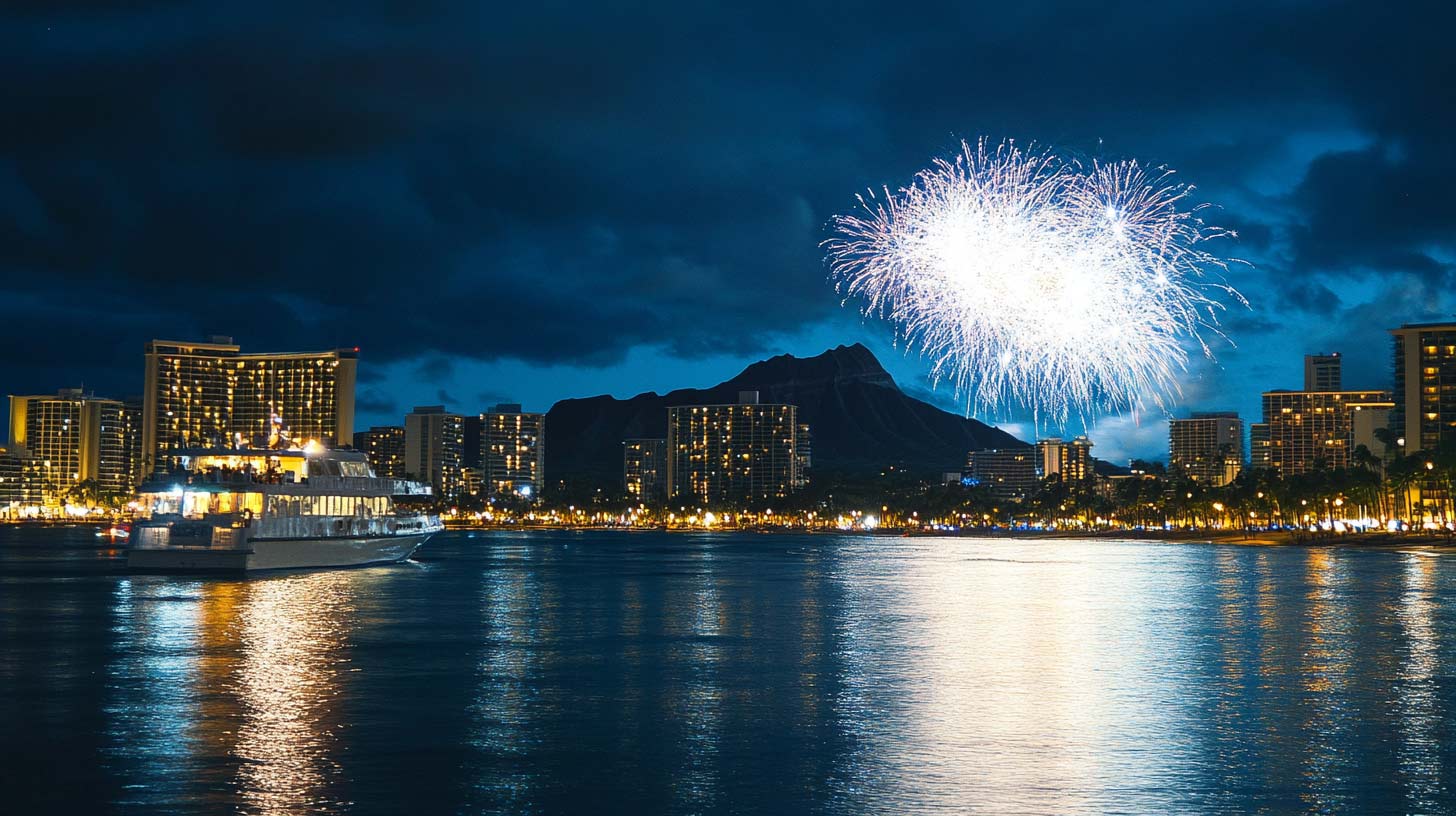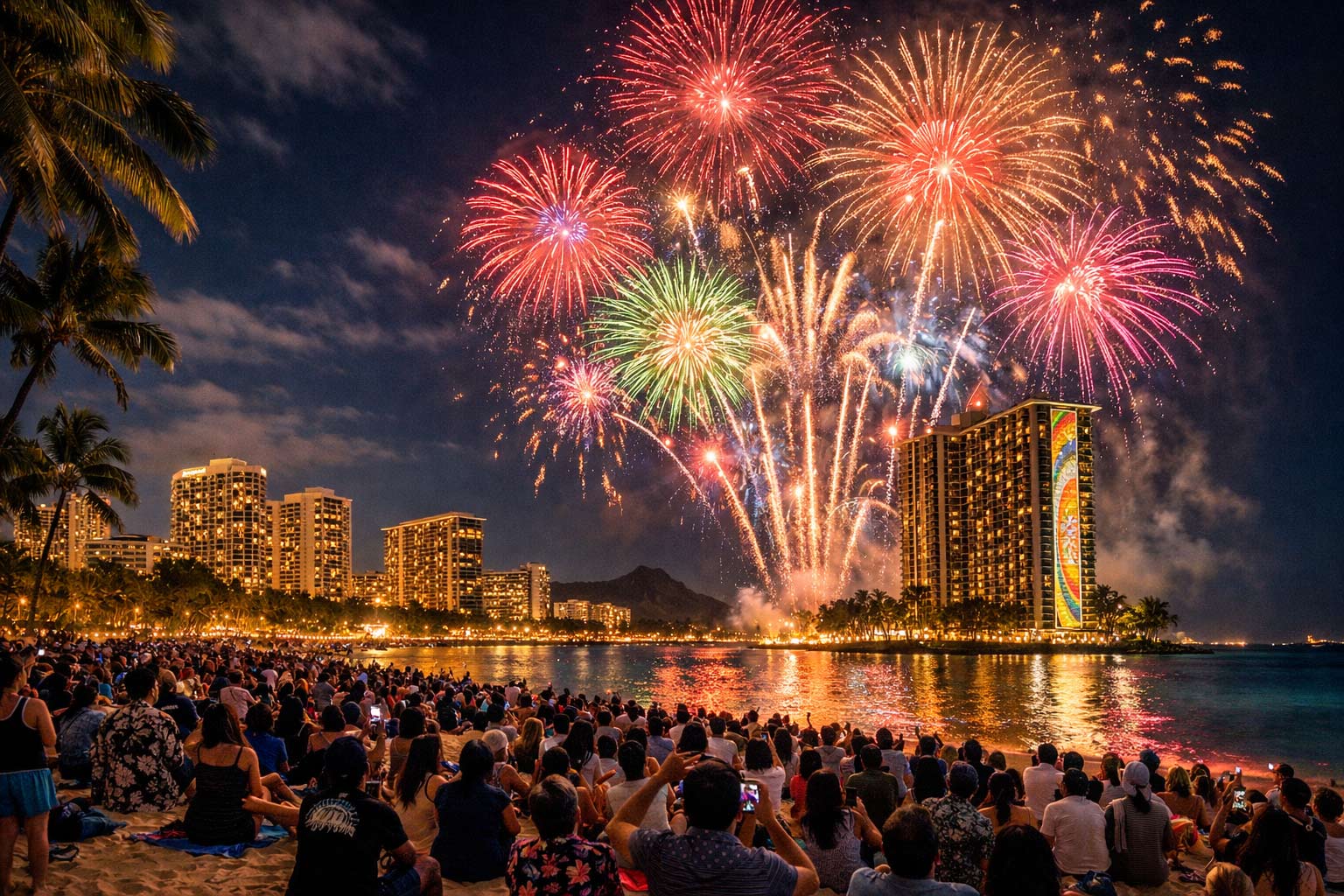
Every Friday night, as the last rays of sunset fade behind the Ko’olau Mountains, a ritual that has defined Waikiki for nearly four decades begins anew. A burst of color explodes over the Pacific. The sky erupts. Onlookers on the beach gasp, children point, couples embrace. The Waikiki Friday Night Fireworks have lit up the Hawaiian sky without interruption since 1988, and if you’ve ever been lucky enough to watch them from the water, you know exactly why this tradition endures.
But where did it all begin? How did a weekly fireworks show become the heartbeat of Waikiki’s Friday nights? And why, even as the world changes around it, does this beloved tradition continue to pack beaches, rooftops, and, most memorably, the open ocean every single week?
The Birth of a Tradition: 1988
The story begins at the Hilton Hawaiian Village Waikiki Beach Resort, still today the largest resort on Oahu, spanning 22 acres of prime Waikiki beachfront. In 1988, the Hilton launched what would become one of the most enduring weekly events in Hawaiian history: the Friday Night Fireworks Celebration.
The initial concept was straightforward: offer guests and the broader Waikiki community a spectacular weekly event that would make Friday nights in Waikiki synonymous with magic. The fireworks would be launched from the roof of the resort, exploding directly over the beach and the Pacific Ocean, visible for miles in every direction.
It was an immediate success. Within months, locals and visitors alike were planning their Hawaii trips around Friday nights. Hotels along the beachfront found their rooftop bars packed. Restaurants reported surging Friday night covers. And on the water, in sailboats, outriggers, and glass-bottom vessels, Waikiki’s maritime community discovered something extraordinary: the view from the ocean was unlike anything else on Earth.
Growth Through the 1990s: A Waikiki Institution
Through the 1990s, the Friday Night Fireworks grew from a novelty event into a Waikiki institution. The show was refined year after year: the pyrotechnics became more elaborate, the synchronization more precise, and the variety of the displays more impressive.
The Hilton’s commitment to the show, even through economic downturns, was remarkable. The fireworks ran through recessions, through storms, through the challenges that tested the Hawaiian tourism industry. They became a statement: whatever else was happening in the world, Friday night in Waikiki was special.
Meanwhile, on the water, an entire ecosystem of fireworks-watching cruises developed. Sailboats, catamarans, dinner cruise vessels, and specialty boats discovered that the optimal viewing position wasn’t on the beach. It was offshore, where you could see the fireworks burst against the full dome of the Hawaiian sky, their reflections rippling in the Pacific below you.
The 2000s: Surviving the Storm
The early 2000s brought challenges to Waikiki’s tourism industry, as they did to tourism worldwide. The September 11 attacks in 2001 devastated Hawaiian visitor numbers almost overnight. The Iraq War, SARS, and a series of economic wobbles meant that the decade was turbulent for Hawaii’s tourism-dependent economy.
Yet through it all, the Friday Night Fireworks continued. They became, in a strange way, a symbol of resilience, of Waikiki’s refusal to stop celebrating. Locals who might never afford a hotel room on the beachfront could still set up a beach chair on Friday night and watch the same show as the guests in the rooftop suites above them. There was something deeply democratic about that.
The show also evolved. New technology in pyrotechnics allowed for more sophisticated designs: shapes, patterns, and color combinations that would have been impossible in 1988. The 2000s also saw the rise of digital photography, and suddenly the fireworks became a viral phenomenon, shared across the early internet and, eventually, social media.
The 2010s: Instagram, Social Media, and a New Audience
The 2010s brought social media to the center of the Waikiki experience, and the Friday Night Fireworks were among the biggest beneficiaries. Instagram, launched in 2010, proved to be a perfect canvas for fireworks photography. The images that emerged, fireworks exploding against the silhouette of Diamond Head, fireworks reflected in the ocean’s surface, fireworks viewed from a sailing vessel with guests raising their glasses in celebration, spread across the world.
Suddenly, the Friday Night Fireworks weren’t just a Waikiki tradition. They were a bucket list experience. Travel bloggers, honeymooners, and adventure seekers added “watch the Waikiki fireworks from a cruise boat” to their must-do lists long before they booked their flights. The fireworks were on Pinterest boards, YouTube videos, and Instagram feeds in dozens of countries.
This period also saw the maturation of the Waikiki fireworks cruise industry. Operators who had been offering basic boat trips discovered that the Friday night experience was their most valuable product. The diversity of cruise options expanded: intimate sailboat charters, glass-bottom boat experiences that let you watch the fireworks reflected through the Pacific’s crystal waters, romantic gondola cruises, and elaborate dinner cruise productions with open bars and live entertainment.
COVID-19: The One Pause (2020–2021)
For the first time in over three decades, the Friday Night Fireworks paused during the COVID-19 pandemic. Hawaii implemented some of the strictest travel restrictions in the United States, and for several months in 2020, Waikiki, one of the most visited destinations in the world, was virtually empty.
The silence where the fireworks used to be was, by all accounts, eerie. Locals who had grown up with the Friday night tradition as an immutable backdrop to their lives noticed its absence acutely. It became, in retrospect, a testament to how deeply the fireworks had embedded themselves into Waikiki’s identity.
When the fireworks returned, as Hawaii cautiously re-opened to visitors, the reception was extraordinary. The first Friday night back, beaches were packed. Boats were fully booked. People cheered when the first burst of color appeared in the sky. It felt, for many, like a homecoming.
2022–2026: Stronger Than Ever
The post-pandemic years have seen the Waikiki Friday Night Fireworks reach new heights of popularity. Hawaii’s tourism recovery was remarkable, and the fireworks tradition, having survived even a global pandemic, emerged with renewed cultural significance.
Today, the fireworks draw crowds of thousands to Waikiki Beach every Friday night. The cruise industry around them has expanded and matured. Operators offer experiences across every budget and taste, from budget-friendly group cruises to ultra-exclusive private charters where you might be one of only a handful of people watching the entire show from the open Pacific.
The Hilton Hawaiian Village continues to invest in the show, maintaining the production quality that has defined it for nearly four decades. The pyrotechnics are spectacular: a 10-to-15 minute show that somehow manages to pack in everything from quiet, twinkling silver bursts to thunderous, horizon-filling explosions of gold and crimson.
By the Numbers: A Staggering Legacy
Consider the mathematics of this tradition:
- Started: 1988, over 37 years of consecutive weekly shows
- Frequency: Every Friday night, 52 times per year
- Total shows: Approximately 1,900+ Friday night fireworks displays (as of 2026)
- Estimated audience per show: Tens of thousands of beachfront and ocean viewers
- Cumulative viewers: Tens of millions over the history of the show
There are very few recurring events anywhere in the world that can match this record of consistency and longevity. The Waikiki Friday Night Fireworks are, by any measure, one of the most successful ongoing weekly events in American history.
Why the Water is the Best Seat
Of all the ways to watch the Waikiki fireworks, from the beach, from a hotel balcony, from a rooftop bar, the overwhelming consensus among those who have tried multiple vantage points is that the water wins. Every time.
The reasons are both practical and poetic. Practically, on a boat you have an unobstructed 360-degree view of the sky. There are no buildings, no palm trees, no crowds pressing against you. The fireworks burst overhead in their full, glorious arc, and when they go off, you can hear them, feel them, smell the sulfur and smoke drifting on the sea breeze.
Poetically, there’s something almost spiritual about watching fireworks from the ocean. The reflections in the water create a double image: fireworks above, fireworks below, as if the Pacific itself is celebrating. The gentle rocking of the boat, the warm Hawaiian air, the sound of the waves beneath the thundering bursts overhead: it’s a sensory experience that photographs cannot fully capture.
It’s the reason that, every Friday night, boats of all sizes make their way offshore from Waikiki. The tradition of watching from the water is now almost as old as the fireworks themselves.
The Next Chapter: 2026 and Beyond
As the Friday Night Fireworks approach their 40th anniversary, the tradition shows no signs of slowing. If anything, the combination of post-pandemic pent-up travel demand, the continuing growth of social media as a discovery platform, and Hawaii’s enduring appeal as one of the world’s premier travel destinations suggests that the fireworks’ best years may still be ahead.
New technologies are beginning to augment the experience, and some operators now offer drone photography services to capture your cruise during the fireworks, and high-definition livestreams have begun to bring the show to global audiences in real time.
But for all the technology, the essential experience remains what it has always been: a Friday night on the water, beneath the Hawaiian sky, watching the fireworks light up the Pacific. Simple. Extraordinary. Irreplaceable.
If you’ve never watched the Waikiki Friday Night Fireworks from a boat, the history of this tradition alone should convince you: some experiences are worth getting right. Book a cruise. Make it Friday night. Watch the fireworks from where they were always meant to be seen: from the open ocean, with the reflections shimmering below and the sky ablaze above.
The tradition has been waiting for you since 1988.